Adio Provvedi's story
Adio Provvedi was born on a farm near Allerona, in a landscape where Lazio, Umbria and Tuscany almost meet. In the years before his birth, his family had lived on a holding on the border between Sorano and Acquapendente. Their roots in the area stretch back much further: in the nineteenth century, his father’s family lived at Monaldesca, now part of the Monte Rufeno Nature Reserve. Decades later, Adio himself would return there, working from the late 1980s until 2004.
The story of his family follows the rhythms of rural Italy in the last century. They once kept horses, used for forestry work, hauling timber and threshing. His grandfather used to say the animals were stolen. After that, the family became sharecroppers. Life was structured, demanding: at least two men always had to be present on a farm.
At the beginning of the twentieth century, tenant farmers were expected to show deference to landowners. Adio’s family refused. Within two years, they were turned out. After moving between several farms, they eventually settled at Sopano, the last farmstead in Montorio towards Acquapendente. At one point, there were 21 people living together.
His mother came from Montorio. When her family moved to a nearby farm along the road to Acquapendente, the two families met—bringing with them different habits, recipes and ways of cooking that would quietly merge over time.

Food was shaped by necessity, season and labour. The family kept sheep—once a sizeable flock, later reduced to just enough to make a little cheese. Breakfast was simple: barley coffee, sometimes with milk, and, when available, ricotta. This first meal, eaten immediately after waking, was known as lo sdigiuno. Only after hours of work would they eat again: polenta, and on Sundays perhaps enriched with a meat sauce, slow-cooked over time.
Their cooking made use of everything. Bread soup, much like Tuscan ribollita, combined fried onion, foraged greens and stale bread, finished with a single egg shared among all. In autumn, wild mushrooms—gialletti—would be added. On Sundays, polenta might be served with slow-cooked rabbit, chicken or lamb, in a rich, concentrated sauce known locally as arrabbione. There was no choice at the table: portions were handed out, and the most prized pieces were often the humblest—chicken feet, gizzards, the parts that required patience and appetite.
Nothing was wasted. When a hen was slaughtered, even undeveloped yolks and intestines went into the pot, in a dish reminiscent of Florentine cibreo. Sauces were made from offal. Pasta, sold loose at the time, was prepared at home on Sundays and dressed simply with homemade pecorino. Olive oil was used sparingly, reserved for finishing; lard was the everyday fat.
There were rituals to the year. Pigs were slaughtered only in winter—one in early December, another at Epiphany—and every part was preserved. Even bones were boiled again later, to extract whatever flavour remained. In summer, meals grew lighter: eggs, bread, wild greens, garden vegetables, perhaps a chicken stretched over several days.
Polenta, the staple, was endlessly adaptable—served with sauce, with grilled salt cod dressed in fresh olive oil, or layered with cheese into a baked dish. Leftovers were never discarded, but sliced and grilled over embers.
In this world, cooking was knowledge passed on quietly. With no daughters in the family, Adio’s mother taught all her children to cook—a small but significant break from expectation.
Adio never lost that connection. He began cooking professionally almost by accident in the late 1980s, when a cook left the cooperative where he was working. From there, food became central to his life, though he still approaches it with a mix of instinct and stubborn independence: he listens to advice, but ultimately follows his own judgement.
Today, he runs the Hosteria di Villalba, managed by a social cooperative. He describes himself, half seriously, as a strict traditionalist. The guiding principle is simple: to recreate the dishes of the past using seasonal, local ingredients. Even so, tradition is something negotiated daily—he jokes that the cooks sometimes claim a recipe comes from their grandmother just to persuade him to accept it.
The dishes he serves are rooted in memory. Potatoes sautéed with garlic and wild fennel. Pigeon, his favourite, cooked in different ways—its flavour stronger, less immediately familiar to modern diners. “With pigeon,” he says, “you eat three times: first the bread in the sauce, then the meat, and finally what’s left on the bones.”
He has little patience for certain modern tastes. Chicken breast, to him, is the blandest cut: “Meat should be cooked on the bone.” The shift from whole cuts to ever more refined portions strikes him as a loss. The same goes for wine. A committed advocate of natural wines, he dismisses the idea that they taste unusual: “It’s the other wine that tastes strange.”
There are dishes that mark time and memory. Roast goose stuffed with potatoes and offal, once prepared at the end of the threshing season. Sagna, their version of lasagne, made with scraps and a little cheese. Even sweet tortelli, filled with ricotta, sugar and cinnamon but served with ragù, speak of older connections—of territories once linked under the Duchy of Santa Fiora, and traditions that blur the line between sweet and savoury.

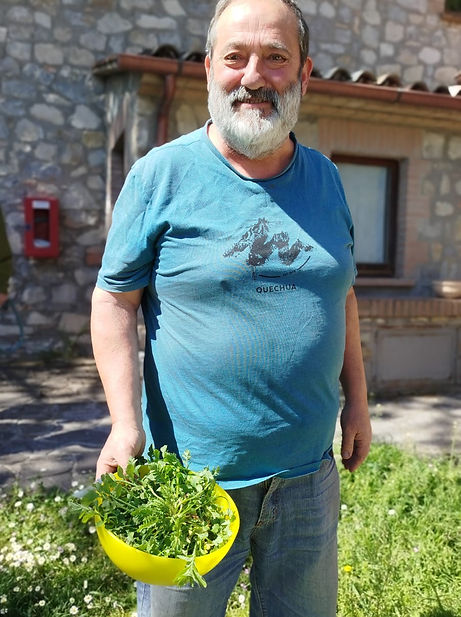
Collecting nettles
For Adio, food cannot be separated from history. Nor from the pace of life that produced it. What he values is slowness: the time needed to grow, to cook, to understand. In a world that has largely moved on, he continues to work within that older rhythm—less out of nostalgia than conviction.
In 2021, he published a book tracing routes across the white roads between Lazio, Umbria and Tuscany, telling stories of rural resistance. The title suggests alternatives—other ways of moving, of living. It could just as easily describe his cooking.
Because in the end, what Adio preserves is not just a set of recipes, but a way of seeing the world: one in which nothing is wasted, everything has its time, and value is measured not by abundance, but by attention.
Cutting the wedding cake with her husband
Harvesting wild greens